Every business office gets the same question sooner or later. Science says it printed far less than Art, Art says the copier lease is the copier lease, and somebody wants to know what a page actually costs. Without a number per page, there is no fair way to split the bill.
This article explains how to calculate printing cost per page for a school, what goes into it, why black and white and colour need separate rates, and why the paper should be priced on its own. The last part shows how KyberCopy turns a price list into a cost on every job and a monthly bill per department, using the demo school's own figures.
What a printed page really costs#
A page off a school copier has three costs in it, and they are paid in different ways.
- Toner or the click charge. On a leased copier the contract usually charges a fixed amount for every side printed, called a click charge, with toner included. On a printer the school owns, the cost is the toner cartridge spread over the pages it prints.
- Paper. Paid by the ream or the case, and used by the sheet, not by the side.
- Finishing. Staples, punching, folding and booklet making. These are paid per finished copy, not per page.
There are other costs, such as the lease itself, the service contract and the time of the person who runs the copy room. Some schools fold them into the rate and some do not. Whatever you choose, write it down, because the next person to ask will want to know what the number includes.
Sides and sheets are not the same thing#
A sheet is one piece of paper. A side is one face of it. A double-sided sheet is two sides. The glossary entry on sheets and sides has the short version.
The distinction matters because toner and click charges are counted in sides, while paper is counted in sheets. Printing double-sided halves the paper but not the toner. A price that only counts sheets charges a double-sided job too little for toner. A price that only counts sides charges it the same as a single-sided one, and takes away the reason to print double-sided at all.
So a fair cost per page has two parts: a rate per side, and a rate per sheet of paper on top.
How to calculate printing cost per page#
Work out each part on its own, from your own invoices, then add them up.
The rate per side, black and white#
On a leased copier with a click charge, the rate per black and white side is the click charge in the contract. Read it off the last invoice rather than the quote, because contracts often have a different rate once a monthly allowance is used up.
On a printer the school owns, divide the price of a black toner cartridge by the number of pages it is rated for. That rating is the page yield printed on the box or the product page. It is measured with a standard test page of mostly text, so a worksheet full of pictures uses the toner up sooner.
The rate per side, colour#
Colour needs its own rate, because a colour page uses up to four toners and leased copiers charge a separate, higher click for it. On an owned printer, add the cost per page of each colour cartridge to the black.
Keep the two rates separate. One blended rate either overcharges the department that only prints black and white tests or undercharges the art department's colour posters. The article on colour vs black and white printing covers the gap and how to keep colour for the jobs that need it.
Paper, per sheet#
Divide the price of a case of paper by the number of sheets in it. Do the same for any heavier or larger paper you stock, such as cardstock or 11x17, if it is a large part of what you print.
Finishing, per finished copy#
A stapled set of thirty is thirty staples, whatever the page count. Price finishing per finished copy, not per page, and leave it at zero for anything you do not want to charge for.
Putting it together#
The cost of one job is then:
- sides printed times the side rate, black and white or colour;
- plus sheets used times the paper rate;
- plus finished copies times the finishing price, for each kind of finishing.
Round once, at the end. Rates like these are often fractions of a cent, and rounding each part separately drifts by a cent on every job.
The free printing cost per page calculator does this sum in a spreadsheet: type in each job's pages, copies and sides with your rates, and it works out the sides, the sheets and the cost.
A worked example, with the demo school's prices#
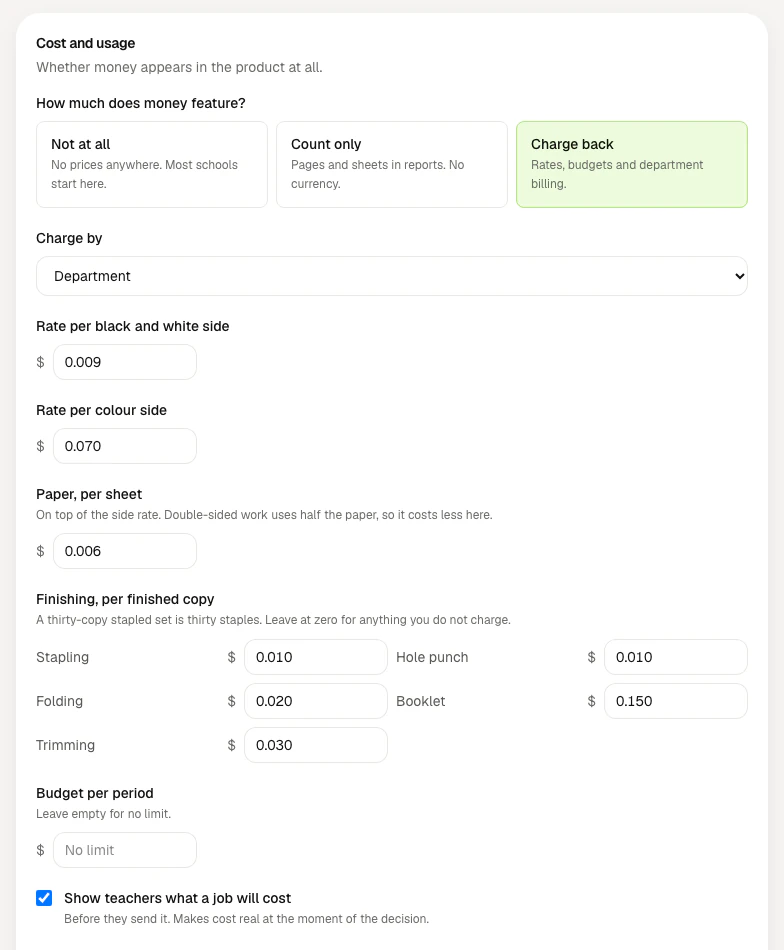
KyberCopy's demo school, Northfield Academy, uses these rates. They are the demo school's settings, not a quote or an average for real schools.
Take a four-page worksheet, thirty copies, black and white.
| Single-sided | Double-sided | |
|---|---|---|
| Sides | 120 | 120 |
| Sheets | 120 | 60 |
| Sides at $0.009 | $1.08 | $1.08 |
| Paper at $0.006 | $0.72 | $0.36 |
| Total | $1.80 | $1.44 |
Double-sided saves exactly the paper, 36 cents, and nothing else. That is the price list telling the truth about where the money goes.
Staple each copy and the double-sided job gains thirty staples at one cent each, for $1.74. Print the same worksheet in colour, double-sided and unstapled, and it comes to $8.76, because 120 colour sides at seven cents is $8.40.
Divide back down and you get the cost per page people ask for. In the demo school a black and white page printed double-sided costs 1.2 cents, and printed single-sided it costs 1.5 cents.
Common mistakes#
Using one rate for everything. A blended rate hides exactly the thing a business office wants to see: who is printing in colour.
Charging per sheet only. It is easy to count, but it charges a double-sided colour job half what the toner cost.
Re-pricing old work. If the rates change in March and every report since September changes with them, last term's bills stop matching what was sent. A job's price should be fixed when the job is printed.
Counting what was asked for, not what was printed. A job that was cancelled, or held and never released, did not use any paper. Only finished work should reach the bill.
Leaving people without a department. Printing by someone with no department has nowhere to go on the bill, and it tends to grow quietly.
How KyberCopy prices each job#
In KyberCopy the price list lives under Copy room settings, on the Cost tab. "How much does money feature?" has three answers: Not at all, Count only, and Charge back. With Charge back on, the school enters a rate per black and white side, a rate per colour side, paper per sheet, and prices per finished copy for stapling, hole punch, folding, booklet and trimming, and chooses whether to charge by department, by person or both.
Each job is priced once, when it finishes, and keeps that price. In the words under the Chargeback table: "Each job keeps the price that applied when it finished." Sheets come from what the printer reported after the job, or from the estimate made when it was sent if the printer reports nothing. Sides come from the page count, so a seven-page double-sided document is seven sides on four sheets, not eight.
Teachers see the cost before they send#
A school can turn on "Show teachers what a job will cost". The request form then shows pages, paper and an estimated cost as the teacher fills it in, worked out with the same price list. In the demo school, 120 colour copies of a two-page document from a teacher in Art show $18.24, and the form also says who has to approve it before the copy room sees it.
That $18.24 is the price list at work: 240 colour sides at seven cents is $16.80, and 240 sheets of paper at 0.6 cents is $1.44.
The bill, by department#
On Reports, the Chargeback tab lists each department with its jobs, sheets and spend for the dates chosen, beside its budget and what is left. Remaining turns amber past 80 percent of the budget and red once it is spent. Printing by people with no department collects in an Unassigned row at the bottom, so it is visible rather than lost.
The month can be saved as a PDF or downloaded as a CSV, and it can be emailed to the business office on the 1st of each month. The guide to billing printing back to departments walks through one month from start to finish.
Short answers#
How do I calculate printing cost per page? Add the cost per side, from the click charge or toner price divided by page yield, to the cost of the paper per sheet. Work out black and white and colour separately.
Is double-sided printing cheaper? It uses half the paper. It does not use less toner, so on a per-side contract the saving is the paper only.
How much should a school charge per page? Whatever its own invoices say a page costs. A school bills itself to share costs fairly between departments, not to make money, so the rate should come from the copier contract and paper price, not from a print shop's price list.
Should colour have its own rate? Yes. Colour uses more toner, and leased copiers charge more for each colour side.