A worksheet written in Google Docs on a Sunday night, a permission slip shared by a colleague, a unit plan the whole department edits. Most school writing now lives in Google Docs, and most of it still ends up on paper. Printing a Doc is usually two clicks, but the result depends on settings in two places, the document and the browser, and a shared Doc carries the page setup of whoever made it.
This guide covers how to print from Google Docs on a computer, a Chromebook and a phone, the settings that decide what comes out, how to get a Doc to the copy room as a file that prints the same everywhere, and why a Doc sometimes prints wrong. The last part shows how KyberCopy takes Google Docs, using the demo school's own screens.
How to print a Google Doc, step by step#
- Open the document in Google Docs in the Chrome browser.
- Check the page setup first. Choose File, then Page setup. Make sure Pages is chosen rather than Pageless, the paper size is Letter for a US school, and the margins look sensible.
- Choose File, then Print, or press Ctrl and P on Windows and a Chromebook, Command and P on a Mac.
- Pick the destination, the printer, in Chrome's print dialog. If the printer you want is not listed, choose See more.
- Set the copies and pages. Pages can be All, or a range such as 1-3 or 2, 5.
- Open More settings for paper size, pages per sheet, margins, scale and two-sided printing.
- Check the preview on the left, page by page, then choose Print.
That is the whole job when the printer is in the list and the document was set up for it. Everything below is about the cases where it is not.
The settings that matter#
Settings live in two places, and the document's own setup wins over most of what the dialog says.
In the document: Page setup#
File, then Page setup, holds the settings that decide how the Doc is laid out before it ever reaches a printer.
- Pages or Pageless. A pageless Doc has no page breaks on screen. It is laid out on pages again when it prints, so headings and tables can land somewhere you did not expect. Switching to Pages shows the real breaks while you edit.
- Paper size. Letter for most US schools. A Doc made by someone whose account is set up abroad is often A4, and that is behind many cut-off bottom lines.
- Orientation. Portrait or landscape, for the whole document or, in recent versions, for a section.
- Margins. One inch on every side unless someone changed them. Very narrow margins can put text where the printer cannot reach.
Changing the paper size reflows the document, so check page breaks, tables and pictures afterwards.
In the browser: Chrome's print dialog#
Chrome shows its own print dialog for a Google Doc. Under More settings:
- Paper size should match the document's, usually Letter.
- Pages per sheet prints two or four pages shrunk onto one side.
- Scale should be Default. A custom number left over from another job shrinks or enlarges everything.
- Two-sided, shown as Print on both sides when the printer can, with a choice of flip on long edge or short edge.
- Color or black and white, when the printer offers both.
The dialog only offers what the chosen printer reports. If Print on both sides is missing, the printer did not report it, or it was added with a generic setting.
In other browsers#
In some browsers Google Docs makes a PDF of the document and opens it, or downloads it, instead of showing a dialog of its own. Print that PDF from the viewer that opens it. The page setup still comes from the Doc.
Printing a Google Doc from a Chromebook#
A Chromebook prints a Doc through the same Chrome dialog. The difference is the printer list: a school Chromebook only shows printers that IT has added, usually pushed from the Google Admin console to a group of users or devices. If the list shows only Save as PDF, no printer has been added for that account or that Chromebook. The Chromebook printing article covers the three ways schools set this up and the usual faults.
Printing a Google Doc from a phone or iPad#
In the Google Docs app, open the document, tap the three dots menu, then Share and export, then Print. On an iPhone or iPad that opens the AirPrint sheet, which lists only printers on the same network that speak AirPrint. On Android it opens the phone's own print service. At school, the copier is often on a network the phone cannot reach, so the printer never shows up; the same is true of a school iPad, covered in printing from a school iPad.
Getting a Google Doc to the copy room#
The copy room does not print from your Google account. It prints a file. The safest file to send is a PDF.
- Download it as a PDF. In the Doc, choose File, then Download, then PDF Document. The PDF keeps the page size, margins and fonts exactly as they are, on any computer and any printer.
- Or download it as Word, File, then Download, then Microsoft Word, if the copy room needs to change something. Word can lay a document out slightly differently, so check it.
- Name the file for what it is, such as Unit 4 quiz, not Untitled document.
- Say the page count and the settings you want: copies, double-sided, stapled, by when.
A link to the Doc is not a file. Whoever prints it has to open it with your sharing settings and print it from their own browser, with their own defaults, which is where surprises come from.
Why a Google Doc prints wrong#
The usual reasons, in the order worth checking:
- The bottom line or page number is cut off. The Doc is A4 and the paper is Letter. Change Page setup to Letter, or set Scale to fit in the dialog. The A4 on letter article goes through both.
- Everything is smaller than on screen. Scale in the dialog is a custom number, or pages per sheet is more than 1.
- Page breaks are in odd places. The Doc is pageless, or the paper size changed after it was written. Switch to Pages and check each break.
- Headers, page numbers or pictures moved. The Doc was downloaded as Word and opened elsewhere. Print from a PDF instead.
- It printed one-sided. Print on both sides was not ticked, or the printer did not report two-sided. The double-sided article has the checks.
- The printer is missing from the list. The computer or Chromebook has not had it added, or cannot reach it on the network.
- Nothing came out. The job went to the wrong destination, often Save as PDF, which saves a file instead of printing.
How KyberCopy handles Google Docs#
KyberCopy sits between a teacher's request and the copier. It does not open a teacher's Google account or change a document's page setup. What it does is take the file, check the job against the printer before it is sent, and, where a school sets one up, print Docs saved in a shared Drive folder by themselves. Everything below is from the demo school, which has made-up staff and data.
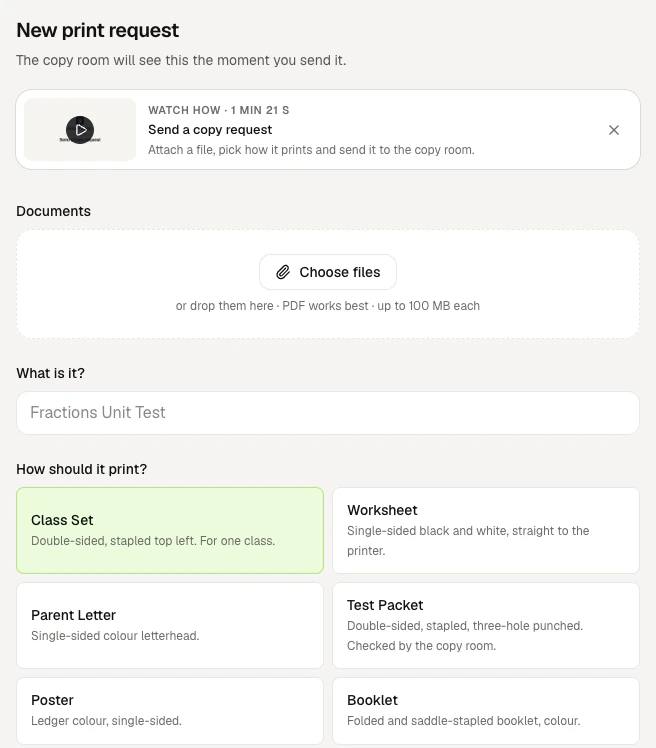
Send the PDF from the request form#
A teacher signs in, opens New request and attaches the file. The form says PDF works best, which is the PDF downloaded from Docs. A Word file downloaded from Docs works too: Word, PowerPoint and Excel files are turned into PDF on the server when the request is sent, and the original is kept beside it.
The teacher picks a preset, such as Class Set or Test Packet, says how many and when, and sends it. Before it goes, the form checks that the printer can do the job as asked. The upload limit is set by the school and is 100 MB a file unless the school changes it.
Emailing a Doc means attaching it#
Teachers can also email the copy room. KyberCopy prints the attachments, not links in the message. An email that holds only a link to a Google Doc gets a reply that reads "That message had no attachment. Attach the document you would like printed." Attaching the PDF downloaded from Docs is the fix.
A Google Drive print folder prints Docs by itself#
A school can link a Google Drive folder to one printer, with its own settings and hours. A Google Doc, Sheet, Slides file or Drawing saved there is turned into a PDF by Google Drive and printed under the name of the person the folder is for, with that person's budget and approvals.
A Doc prints once it has sat unchanged for two minutes, so one still being typed is not printed half-written. Google will not export a Doc whose PDF would be larger than 10 MB; that file is refused with the reason, and saving it as a PDF in the folder is the way round it. The Google Drive folder guide shows the setup.
What KyberCopy does not do#
KyberCopy does not scale pages or set margins: each page prints at the size the document was made. It does not change a Doc from A4 to Letter, read a document through a sharing link sent by email, or reach into anyone's Drive beyond a folder shared with it. The page setup is still fixed in the Doc.
Questions people ask#
How do I print from Google Docs? Open the Doc, choose File, then Print, or press Ctrl and P (Command and P on a Mac). Pick the printer in the dialog, check More settings and the preview, then choose Print.
Why won't my printer print from Google Docs? Usually the printer is not in the list for that computer or Chromebook, the destination is Save as PDF, or the device cannot reach the printer on the network. Printing a PDF downloaded from the Doc shows whether the problem is the Doc or the printer.
How do I print a Google Doc double-sided? In Chrome's print dialog, open More settings and tick Print on both sides, then choose long edge for most handouts. If the option is missing, the printer did not report two-sided printing.
Can you print from Google Docs without downloading? Yes, from Chrome's print dialog. To send a Doc to someone else to print, such as the copy room, download it as a PDF so it prints the same on their computer.
Why does my Google Doc print smaller than it looks? Scale is set to a custom number, pages per sheet is above 1, or an A4 Doc is being fitted onto Letter paper.